
Kristian Studios - services
What we do and how we do it
Three connected disciplines — architectural illustration, signage and wayfinding consulting, and environmental graphic design — that together take a project from its first sketch to a finished, branded space.
Each service can be engaged independently. Most projects benefit from more than one. All of them are grounded in the same process: research first, drawing as communication, and documentation that actually holds up in the field.
Our core service - & where we deliver the most value to you
Service 01 - Signage & Wayfinding Consulting
Signage that works starts in the construction documents — not in the allowance line at the end of a bid. We engage during design development so your sign family, message schedule, location plans, and Division 10 specifications are ready at 50% CDs. That protects your budget, your bid, and your certificate of occupancy.
We are independent consultants. We don't fabricate signs. That means our specifications are written to represent your client's interests — not to move a preferred vendor's product. Every fabricator bids the same scope. The spec is enforceable. And when submittals come in, we review them against the standard we set.

Sign Family Design
Sign Family Design
Sign Family Design

A cohesive sign family integrated with the surrounding architecture — ensuring aesthetic continuity, brand alignment, and functional clarity throughout the project. Developed with time for code review and client approvals.
Deliverable: sign family drawings
Message Scheduling
Sign Family Design
Sign Family Design
A complete message schedule — analogous to a door or fixture schedule — listing every sign type, material, placement location, message content, and quantity. Prevents miscounts, misinterpretations, and change orders.
Deliverable: Message Schedule Document
Location Plans
Sign Family Design
Division 10 Specifications
Floor plans and site plans annotated for sign placement, mounting requirements, and installation verification. Includes coordination of blocking, electrical, and hardware requirements for location-specific installations.
Deliverable: Annotated floor & site plans
Division 10 Specifications
Budgeting & Program Development
Division 10 Specifications
Full signage specifications under Division 10 14 00 — covering materials, fabrication standards, approved vendors, functionality, and ADA/code compliance. Without a detailed spec set, manufacturers interpret freely and bids are never apples-to-apples.
Deliverable: spec section 10-14-00
Budgeting & Program Development
Budgeting & Program Development
Budgeting & Program Development
Creating a Sign program early in the design development process ensures accurate budgeti
Early-phase budget development for signage programs, with guidance on whether open sub-bidding or an allowance approach is appropriate. Accurate numbers in design development means no budget surprises at construction.
Deliverable: Program budget summary
Project Management & Support
Budgeting & Program Development
Budgeting & Program Development
Full project support from conceptual design through punch list and handover — including site surveys, code review, vendor recommendations, submittal review, and installation verification. We stay in the project as long as you need us.
Deliverable: Ongoing PM support
Clear design, align stakeholders, & support project approval
Service 02 - Architectural Illustration
A hand-drawn illustration does something a digital render can't: it invites reaction. When a sketch looks like it's still in process, clients and stakeholders feel they can question it, change it, and participate in it. That's not a weakness of the medium — it's the point.
We work with architects during schematic design, with developers seeking approvals or community support, and with preservation clients who need documentation that meets HABS/HAER and Section 106 standards. Every illustration begins with site research and a conversation about what the drawing needs to communicate — not just what it needs to look like.
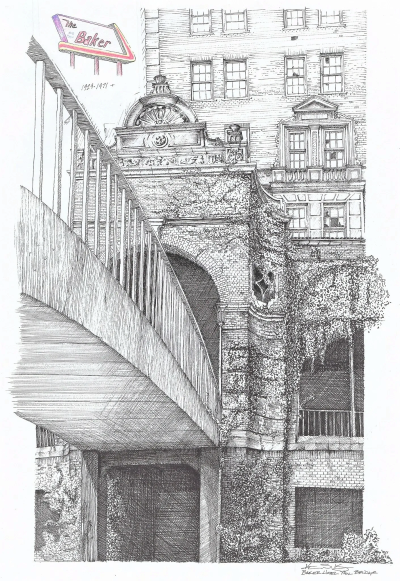

Presentation Illustrations
Community Engagement & Funding Visuals
Presentation Illustrations
Exterior and interior perspectives developed for design review, client approvals, and community presentations. Hand-drawn in pen and ink — conveys scale, materiality, and character in ways digital rendering doesn't.
Deliverable: inked illustration set
Schematic Design Sketches
Community Engagement & Funding Visuals
Presentation Illustrations
Iterative concept sketches that support the design development process. Quick to revise, immediately readable in a meeting, and no software required to understand them. The fastest way to test an idea with a client.
Deliverable: sketch series
Section 106 & HABS/HAER
Community Engagement & Funding Visuals
Community Engagement & Funding Visuals
Classically trained in measured drawing and historic documentation. Compliant with SHPO, NPS, and private firm standards for federal review, adaptive reuse, and full restoration projects.
Deliverable: documentation package
Community Engagement & Funding Visuals
Community Engagement & Funding Visuals
Community Engagement & Funding Visuals
Illustrations for community revitalization, grant applications, and stakeholder presentations. Communicates across technical and language barriers in a way that floor plans and schedules never will.
Deliverable: stakeholder presentation set
From identity to space — brand at architectural scale
Service 03 - Environmental Graphic Design & Brand Implementation
Environmental graphic design sits at the intersection of architecture, brand, and human experience. It's supergraphics that give a lobby its character. Dimensional lettering that communicates permanence. Donor walls built to expand over time. Wayfinding so well integrated with the architecture that people always know where they are without noticing why.
Most brand guidelines stop at screen and print. When a brand hits a building — through signage, wall graphics, and wayfinding — there's typically no guidance for how it should perform at scale, on materials, in construction. We bridge that gap, developing environmental standards that every fabricator and contractor on the job can work from consistently.
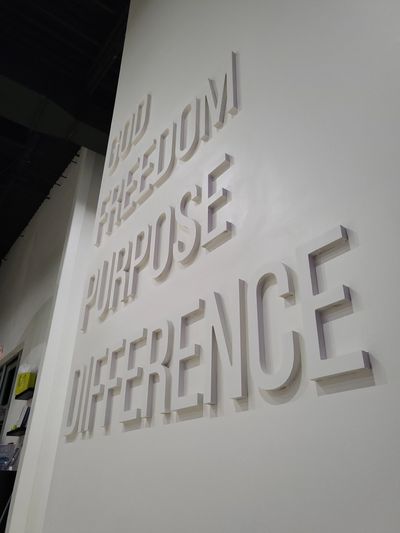
Creative Graphic Design Services
Supergraphics & wall graphics
Dimensional lettering & feature graphics
Dimensional lettering & feature graphics
Large-format graphics that define spatial character, reinforce brand identity, or carry a narrative story. Designed at full scale with material and installation constraints addressed in the drawing set.
Deliverable: graphic design + install documents
Dimensional lettering & feature graphics
Dimensional lettering & feature graphics
Dimensional lettering & feature graphics
Channel letters, dimensional logos, and architectural feature elements designed for built integration — with fabrication-ready drawings and complete material specifications.
Deliverable: fabrication-ready drawings
Interpretive & donor recognition panels
Dimensional lettering & feature graphics
Brand implementation & environmental standards
Exhibit-quality interpretive panels for museums, historic sites, and civic spaces. Donor walls and recognition systems designed to be maintainable and expandable without a full redesign.
Deliverable: panel design + content layout
Brand implementation & environmental standards
Brand implementation & environmental standards
Brand implementation & environmental standards
Environmental brand guidelines that translate a 2D identity into architectural applications — color on materials, typography at scale, logo placement and clearance on built surfaces. For new brands, we develop identity with built application in mind from the first sketch.
Deliverable: environmental brand guide
Logo & identity development
Brand implementation & environmental standards
Logo & identity development
Original logo and identity designed with built environments in mind — contrast ratios, minimum sizes, and material behavior considered from the start so the mark performs at architectural scale, not just on a business card.
Deliverable: identity package
Product Design
Brand implementation & environmental standards
Logo & identity development
Product Development and branded product design.
Deliverable: production-ready artwork